
What utopia looks like for Australian’s according to data
The concept of utopia is of an ideal society, or a blueprint for a better world, and has been mulled over by philosophers, writers, architects, and more for centuries.
While the specific details may have changed and evolved over time, the core themes and characteristics can be found across cultures. As per a journal article from 2022 titled UTOPIA: THE IDEAL OR PERFECT SOCIETY, these characteristics include;
- Equality, social justice, and the elimination of social hierarchies
- Cooperation and communal living, where individuals work together for collective good
- Harmonious coexistence with nature, sustainable practices, and environmental stewardship
- Education and intellectual development, with the pursuit of knowledge, personal growth, and lifelong learning a priority
- Participatory decision-making and democratic governance ensure that every individual has a voice in shaping the society
- Elimination of scarcity and the provision of abundance for all
While the concept of a utopian society can seem unattainable or intangible, it serves as a source of inspiration and a catalyst for social and political progress.
For Australians, our version of a “utopia” tends to be grounded, practical and deeply connected to quality of life: affordable homes, secure jobs, good health, fairness, safety, a clean environment and time to enjoy it all. Regularly viewed as one of the most liveable countries in the world, our national idea of is more about closing the gaps, not creating something entirely new.
By looking at statistics on what Australians value most, we can build a picture of what an “ideal Australia” looks like in the public imagination.
A fair go: equality and cost of living
One of the strongest themes in Australian identity is the idea of the “fair go.” Surveys consistently show that fairness and equality matter deeply to Australians. A 2021 Navigator survey found that 76% of people in Australia agree that the “fair go” mentality is important.
Cost of living is now the dominant national concern. The Australian Bureau of Statistics (ABS) has shown that living costs rose at their fastest rate in decades during 2022–2023, particularly for housing, food, electricity and fuel (ABS, 2023). At the same time, recent national polling found that cost of living remains the top voting concern for Australians in both an Essential Report (53%) and Roy Morgan (57%) surveys.
Housing is central to this anxiety. Home ownership has steadily been declining in Australia with research from AHURI demonstrating that “over the last 30 years, ownership rates for households at age 30 to 34 have declined substantially; from 65 per cent of people born in the mid to late 1950s being home owners by age 30 to 34, to only 45 per cent of people born in the mid to late 1980s.”
A 2021 Australia Talks national survey found 65% of Australians in general think owning a home isn’t really an option for most young Australians anymore.
In an ideal Australia, most people imagine a country where working full-time is enough to afford rent or a mortgage, bills and some savings — not just survival. Utopia, for many, is simply not being constantly financially stressed.
Health and wellbeing: living longer and better
Australians hold a sense of pride in our healthcare system, and it plays a huge role in how we define a good society.
Australia has one of the highest life expectancies in the world at around 83 years, placing it in the global top ten.
However, mental health is now one of the leading contributors to illness burden in Australia, particularly among young people.
This creates a clear picture of utopia: a country where healthcare is not only accessible but proactive, where mental health services are easy to get, and where waiting times, out-of-pocket costs and rural access gaps are reduced. An ideal Australia is one where being sick doesn’t mean being financially punished.
Work-life balance
Australians value lifestyle as much as — if not more than — income. International surveys consistently rank Australia highly for work-life balance.
Research from Humanforce in 2024 revealed that nearly half of the 500 Australian workers surveyed switched jobs in the past year, with 54% citing the pursuit of better work-life balance and wellbeing as their primary motivation rather than higher pay.
In the SEEK Money Matters report, 65% of Australians would choose work-life balance over higher pay.
In a utopian Australia, people imagine leaving work on time, having weekends free, and not being constantly exhausted. It’s the ability to go to the beach, watch kids’ sport, have a barbecue, or simply rest — without guilt or financial anxiety.
Safety and community
Safety is a major part of how Australians judge quality of life.
An estimated eight million Australians (41 per cent) aged 18 years and over have experienced physical or sexual violence since the age of 15, according to results from the Personal Safety Survey (PSS) released in 2023 by the Australian Bureau of Statistics (ABS).
An Australian utopia is not just safe statistically — it feels safe. It’s a place where kids can walk to school, people know their neighbours, and communities are connected rather than isolated.
Environment
Australians have a strong emotional connection to the natural environment, from beaches and bushland to national parks and reefs.
Over half of Australians think the government is doing too little to protect the environment, while a survey by the Biodiversity Council revealed that 71% of people (3 in 4) believe that governments should have a duty of care to protect future generations from environmental harm, and 81% of people (4 in 5) support measures to protect Australian wildlife of cultural significance, such as the platypus.
For many, utopia includes clean beaches, healthy reefs, green cities and protected wildlife. It is a future where development does not destroy what makes Australia beautiful. The ideal Australia is modern and prosperous, but still recognisably “Australian” in its landscapes.
Multiculturalism and belonging
Australia is one of the most multicultural countries in the world, and most Australians see this as a strength.
The latest Census revealed that in 2021, just over 7 million people in Australia were born overseas, representing 27.6% of the population.
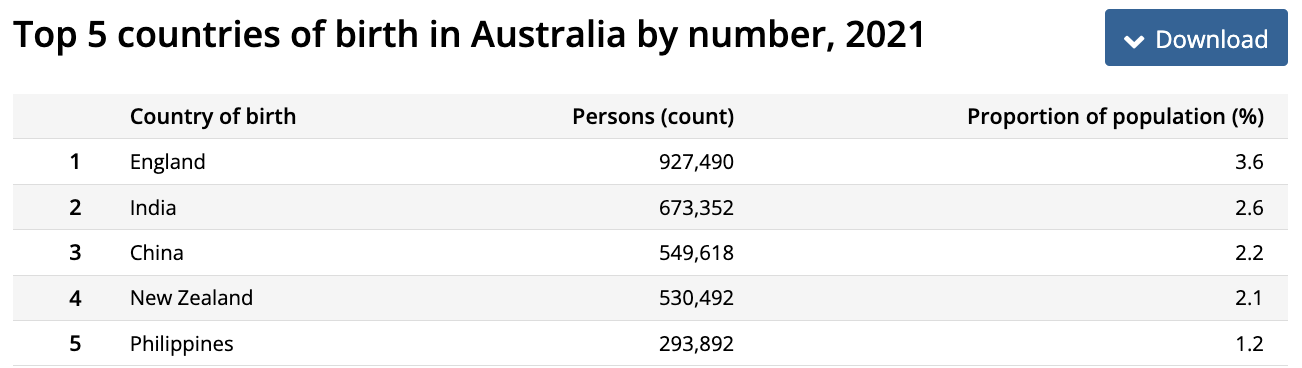
The 2025 Scanlon Institute Mapping Social Cohesion report reveals that while 48% of respondents believe that immigrants take away jobs, 83% still agree that multiculturalism is good for Australia.
A utopian Australia, in the public mind, is inclusive — where people are judged by how they treat others, not by where they come from.
Education and opportunity
Australians strongly believe in education as a pathway to opportunity.
Australia participates in the Programme for International Student Assessment (PISA), which tests 15-year-olds in reading, mathematics and science globally. According to the OECD PISA 2022 country notes, Australian students perform above the OECD average in key areas such as reading and science proficiency.
The latest OECD Education at a Glance report also shows that Australia invests a high share of GDP in education (5.4%), above the OECD average of 4.7%.
In an ideal Australia, every child — regardless of postcode — has access to good schools, safe classrooms and pathways into work or further study. Utopia is a country where talent and drive matters more than background.
When you put all this together, the Australian idea of utopia is surprisingly simple and realistic. It is not about perfection. It is about balance.
An Australian utopia is:
A place where housing is affordable and secure
Where healthcare is accessible and mental health is supported
Where work doesn’t consume life
Where communities feel safe and connected
Where nature is protected, not sacrificed
Where diversity is normal and belonging is shared
And where every child has a genuine chance to succeed
In many ways, Australians already live close to this vision — which is why the national mood is often less about wanting radical change and more about protecting what works and fixing what doesn’t.
For Australians, utopia isn’t a distant fantasy. It’s simply a fair, healthy, safe and beautiful country — for everyone.




