Over the past few years, one question has kept emerging across almost every project we’ve undertaken.
Why are some organisations adapting faster than others?
It doesn’t seem to matter whether we’re working with wineries, manufacturers, retailers, educators, energy providers or governments. Different sectors face different challenges, but remarkably similar conversations continue to surface. Customers are changing. Expectations are changing. Technology is changing. The pace of change itself seems to be accelerating.
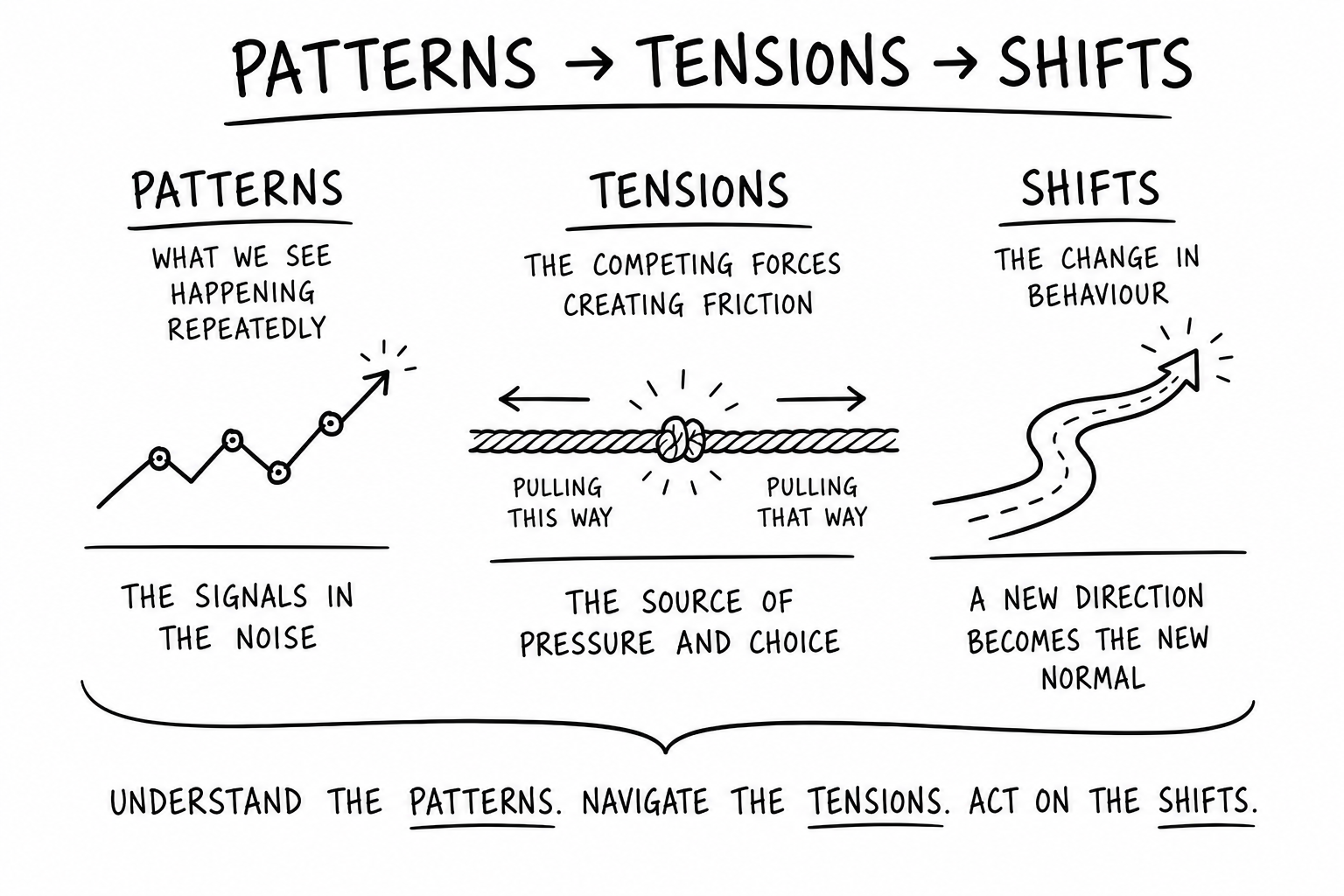
What differs is not necessarily the challenge. It is how organisations respond. One framework we have found increasingly useful is thinking in terms of patterns, tensions and shifts.
Patterns are the signals
They are the conversations that keep appearing, the behaviours that feel slightly different, the questions clients continue asking, or the observations that emerge across multiple sectors. Individually they rarely tell us very much. Together they often point towards something much larger.
Tensions are where the insight usually sits
They represent competing forces that cannot both be fully satisfied. Health versus enjoyment. Value versus affordability. Human judgement versus artificial intelligence. Growth versus sustainability. These tensions create pressure, and pressure changes behaviour.
Shifts are what eventually become visible to everyone
By the time a shift is obvious, organisations are often already reacting to it. The greater opportunity is understanding the patterns and tensions that created it in the first place.
COVID provides a useful example
The shift wasn’t simply that people worked from home. The deeper story was the tension between safety and connection, flexibility and culture, productivity and wellbeing. Those tensions continue to shape workplaces today, long after lockdowns ended.
The same can be said for cost-of-living pressures, artificial intelligence, changing attitudes towards alcohol, or the energy transition. Looking only at the headline misses the more important story underneath.
Understanding people is rarely about measuring what has happened. It is about understanding why it happened.
At first glance, the challenge appeared to be declining wine consumption in pubs, restaurants and bars. That was certainly true. But the more interesting question became why. The conversations quickly moved beyond wine itself. Health. Moderation. Value. Simpler choices. Changing hospitality experiences. Different social occasions. Wine wasn’t simply competing with beer or cocktails. It was competing with changing lifestyles.
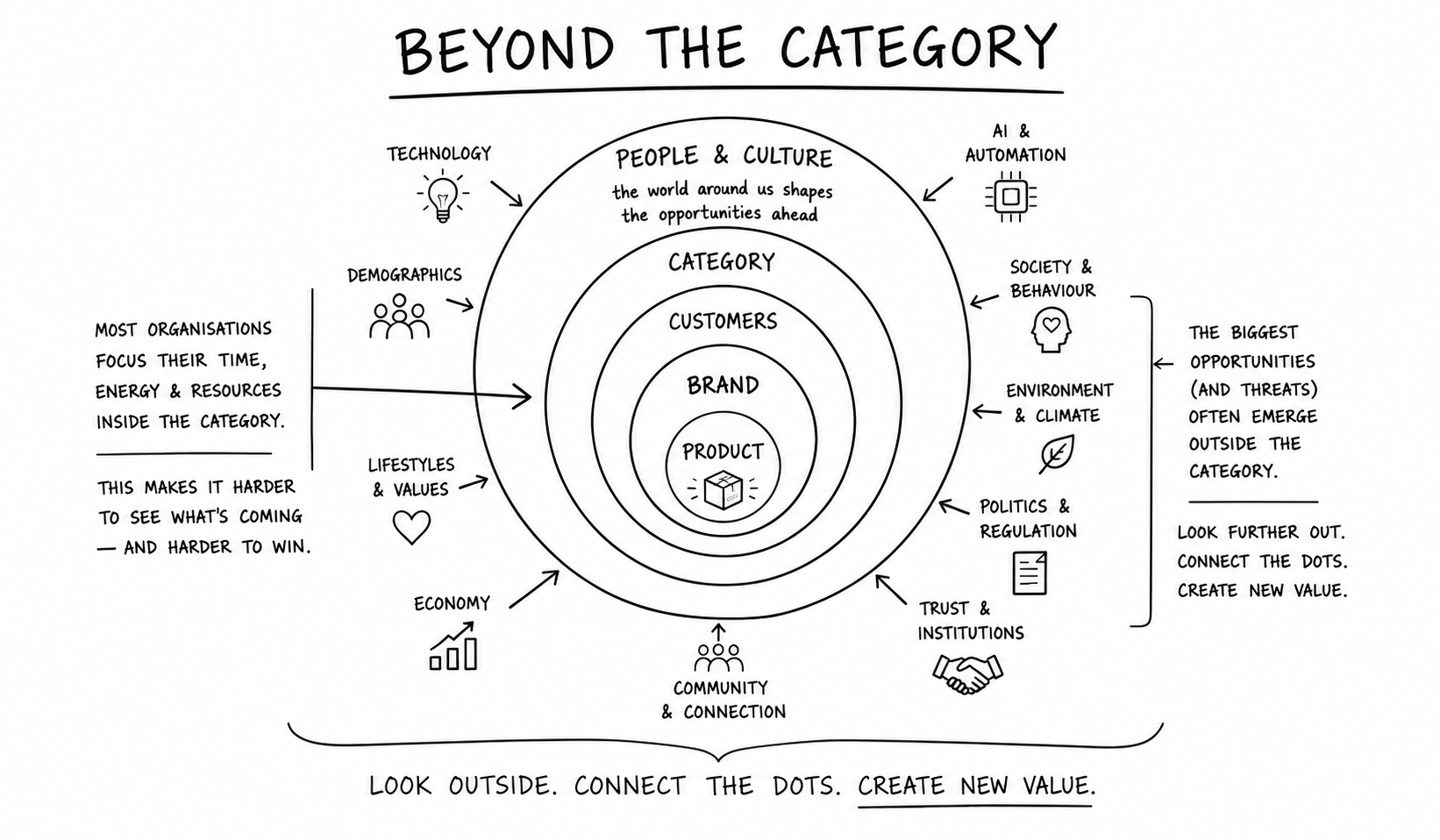
The tension sat outside the category
This is one reason we spend so much time encouraging organisations to look beyond their category. Most businesses naturally benchmark competitors. They compare products, pricing, campaigns and market share. That is important, but it is rarely enough. Many of the forces shaping the future sit elsewhere. Technology. Demographics. Economics. Politics. Culture. Society. Looking wider often reveals opportunities that simply aren’t visible from inside the category.
Curiosity plays an important role here. Not curiosity for curiosity’s sake, but curiosity as a strategic capability. A willingness to ask better questions, challenge assumptions and remain open to evidence that doesn’t fit yesterday’s thinking. Information has never been more abundant. Understanding has never been more valuable.
At Square Holes, we often describe our role as helping organisations make sense of changing people and changing culture. Research is one part of that process. Sensemaking is another. Collecting information is relatively easy. Connecting seemingly unrelated observations, recognising what matters and understanding the implications for future strategy is considerably harder.
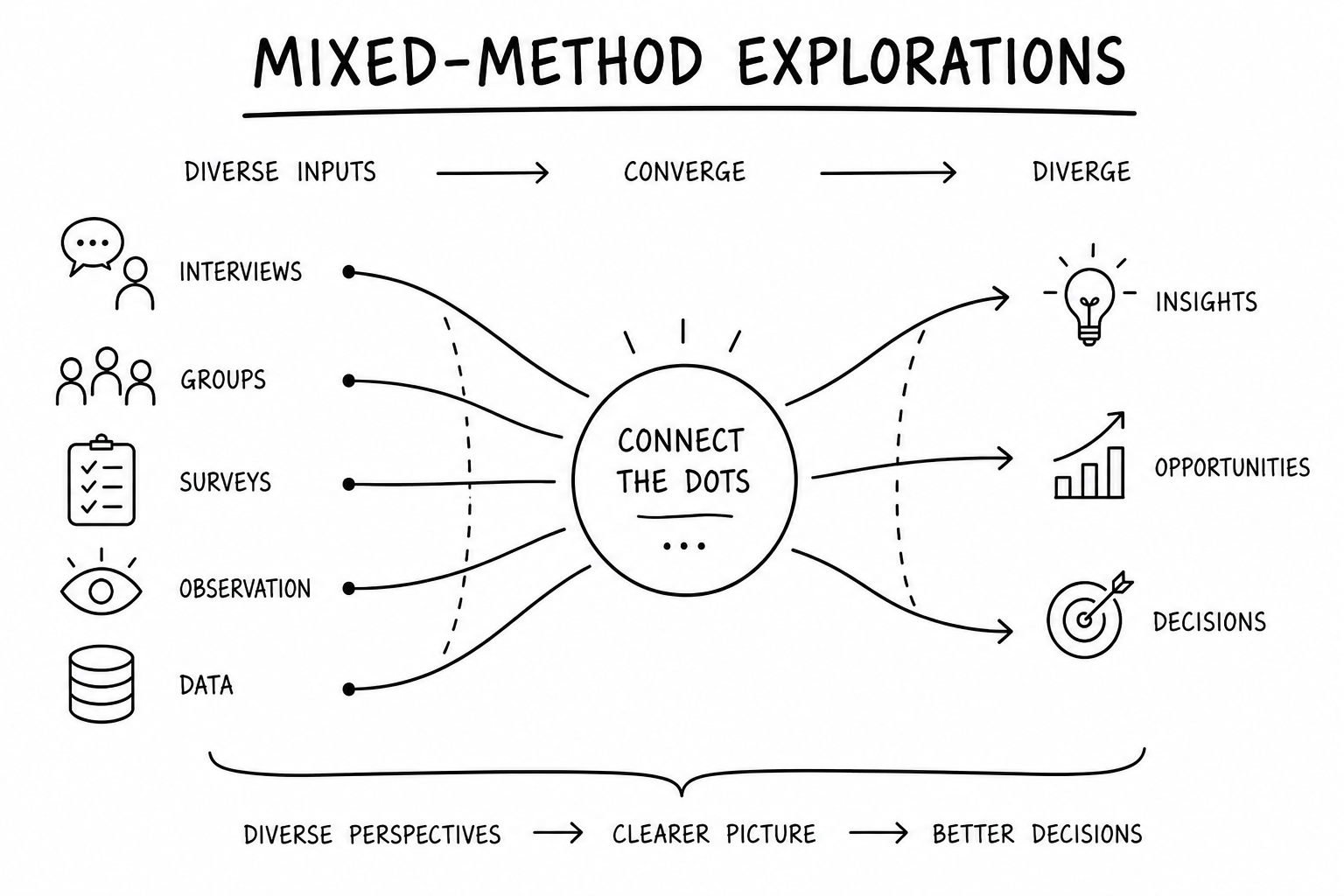
That is why much of our work follows a continuous cycle of exploration, testing and monitoring.
The organisations adapting fastest are rarely those predicting the future with perfect accuracy. More often, they are the organisations continually learning, adjusting and responding as conditions change. Perhaps that is the biggest lesson from the past five years.
The future rarely arrives overnight. It usually begins as a pattern we overlook, a tension we underestimate, or a shift we fail to act on. The question is not whether change is coming.
It is whether we are paying attention early enough.
Square Holes is a cultural insight studio.
We design mixed-method explorations of people and culture beyond the category, uncovering the patterns, tensions and shifts shaping behaviour to inform strategy, inspire innovation and enable confident decisions. Our studio model brings together the right mix of thinkers, researchers and specialists for each exploration.
If you’re navigating change, entering a new market, or seeking deeper understanding of people and culture – let’s start a conversation >
Share this:
Turbo drive imagination
Stay ahead of changing people and culture. Think! is Square Holes’ weekly cultural insight email exploring the patterns, tensions and shifts shaping behaviour.9:30am AEST Fri | 400+ editions | PLEASE JOIN!
Subscribe to Think! eMag
“I really enjoy your emails – full of bite sized bits of good, smart info” – Clare, Think! reader